

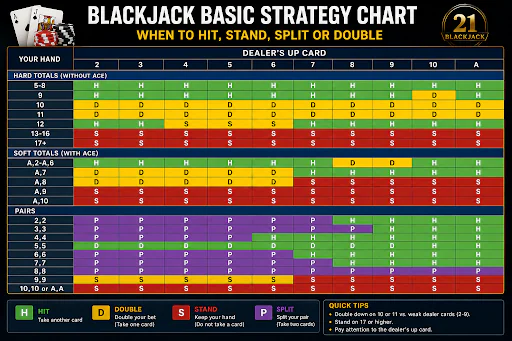
You’ve got a 16. The dealer’s showing a 7. What do you do? Most people freeze up and guess. That’s exactly why the casino keeps winning. A blackjack basic strategy chart fixes that problem. It’s just a table. It tells you the right move for whatever hand you’re holding, based on the one card the dealer shows. Use it and the house edge drops to about 0.5%. Skip it and you’re stuck around 2%. Playing for a few hours and making that difference gets expensive. No chart makes you win every night. But it stops you from handing over money for no reason.
What’s On a Blackjack Basic Strategy Chart
The chart has three sections: hard hands, soft hands and pairs. Your hand runs down one side. The dealer’s card runs across the top. Find where they meet, and that box tells you what to do.
Hard Hands, Soft Hands and Pairs
A hard hand has no score, and an ace is stuck counting as 1. A soft hand has an ace counting as 11, like an ace-6. That gives you some breathing room since you can’t bust right away. A pair is two matching cards. You can split those into two hands if you want.
Beginners usually only think about hard hands. Big mistake. Soft hands and pairs are where most players lose ground without even knowing it.
When to Hit
Hitting means taking another card. You’ll need to hit more than your gut wants you to, especially on hands that feel risky.
Hard Hands: When Hitting Is Right
8 or under, just hit. You can’t bust. Between 12 and 16, check the dealer’s card first. Dealer showing 7 or higher? Hit on 16 or less almost every time. The dealer’s in good shape here, and standing on a weak hand just gives them the win.
When to Stand
Standing feels safe. It isn’t always. Standing too early is one of the fastest ways to throw away your edge.
Hard Hands: When Standing Is Right
17 or higher, stand every single time. Between 12 and 16, only stand if the dealer shows a 4, 5 or 6. Those are bust cards. The dealer’s more likely to go over 21 with one of those showing, so let them take that risk instead of you.
When to Double Down
Doubling down means you double your bet for exactly one more card. Do it at the right moment, and it pays. Do it out of habit, and it costs you.
The Best Hands to Double On
Hard 11 is the strongest double in the game, especially against anything but an ace. A hard 10 comes close, good against everything except a dealer’s 10 or ace. Soft hands like Ace-6 or Ace-7 are worth doubling too, as long as the dealer’s card is weak.
When to Split Pairs
Splitting turns one hand into two, each with its own bet. Some pairs you always split. Some you never touch.
Pairs to Split (and the Ones to Skip)
Aces and eights, split almost every time. Eights add up to 16, one of the worst hands you can hold. Break it into two hands starting at 8 and you’re already better off. Aces split because two blackjacks beat one weak 12 – easy maths.
Tens are the opposite story. Never split a pair of tens. That’s a 20, already one of the strongest hands out there. Breaking it apart just to chase two average hands is a bad trade. Fours and fives usually stay together too.
Why the Dealer’s Card Matters So Much
Every single move on the chart comes back to one thing: what card the dealer’s showing. Skip this part and the rest of the chart won’t make sense.
Dealer 2-6 vs Dealer 7-Ace
Dealer showing 2 through 6? They’re in trouble. More likely to bust, so you can stand on hands that feel too risky otherwise. Dealer showing 7 through Ace? They’re sitting pretty, so you hit more. Standing weak here just walks you straight into a loss.
Once that sinks in, the chart stops looking like something to memorise. It starts making sense on its own.
Card Counting, Betting Systems and Other Myths
You’ll hear about hot streaks, betting patterns, and counting cards. None of it beats math the way basic strategy does. Betting systems just move your money around differently. They don’t touch the house edge. Basic strategy is the only approach actually backed by odds instead of a hunch.
It’s an Edge, Not a Promise
Play every hand perfectly and you can still lose the night. That’s just how variance works. What the chart gives you is the lowest possible loss rate the math allows, instead of extra losses stacked on top from bad calls.
Bringing the Chart to the Table
Most casinos let you keep a strategy card next to you. Playing online? Keep one open in another tab; nobody’s stopping you. Dealers see this constantly. Nobody’s judging.
Practice Before Real Money’s on the Line
Run a few sessions on a free blackjack trainer first. You don’t need all 300-something boxes memorised on day one. Learn the common ones, hard 12 through 16, soft hands, and pairs so you’re not freezing up mid-hand.
Final Thoughts
A blackjack basic strategy chart won’t erase the house edge. Nothing will. What it does is close the gap between how the game’s supposed to be played and how most people actually play it. Start with hard hands. Then soft hands. Then pairs. Once the dealer’s card is driving your decisions instead of your gut, you’re finally playing the game right.