
Three-card poker looks intimidating at a crowded table. It isn’t. No drawing cards, no bluffing across four rounds of betting, no giant list of hand rankings to memorize. Honestly, you can learn three-card poker rules faster than it takes to play a single hand of Hold’em. That’s probably why it’s stuck around on casino floors for decades and shows up on pretty much every online casino’s game list now.
Here’s what you actually need to know: how the game’s set up, the two bets that matter, what beats what, a bit of strategy so you’re not just guessing, and a few things people tend to get wrong the first time they sit down.
How Three-Card Poker Works
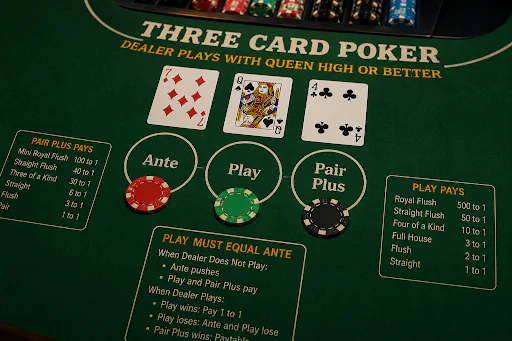
You’re not playing against the other people at the table. Forget reading anyone’s face. You’re only up against the dealer. Everyone puts down an ante bet before cards get dealt, and then you and the dealer each get three cards. You look at yours and decide: fold or throw in a play bet equal to your ante and keep going.
Fold, and you lose the ante hand over. Play, and your three cards go head to head with the dealer’s three cards. Better hand wins.
One thing worth mentioning: the pace here is fast. There’s no waiting on other players to make decisions, no side conversations dragging out a round. You see your cards, you make one call, and the hand resolves within seconds. That’s part of the appeal if you’ve ever felt bored waiting at a slow poker table.
The Two Bets You’ll Actually Place
The ante is mandatory; that’s your buy-in to see cards. The play bet is your call after you’ve looked at your hand and decided it’s worth continuing. Most tables also offer a side bet called Pair Plus, which just pays based on your hand alone; the dealer’s cards don’t even factor in, as long as you land a pair or better.
Some tables spread a side bet called “6 Card Bonus” : your three cards plus the dealer’s three, best five-card hand wins. Separate bet, separate payout table, doesn’t change how you play your actual hand.
Hand Rankings (And the One Weird Twist)
Straight flush, three of a kind, straight, flush, pair, high card – from best to worst.
Yes, a straight is better than a flush. It might take some time to get used to if you’ve been playing five-card poker all your life. No, there’s no mistake about the number of cards – straights really do appear less often than flushes, which is why the ranking was switched around.
Why It Flips
Do the math on a 52-card deck, and there are more three-card straight combos that aren’t also flushes than there are flush combos, period. Rarer hand, higher rank. Simple as that, even if it feels wrong the first few times you play.
The Dealer Has to Qualify
The dealer needs a queen-high or better to even be in the game. No qualify? Your ante just pays even money automatically, and your play bet pushes; you get it back, with no win and no loss. If the dealer does qualify, everything gets compared straight up.
This qualifying thing isn’t just a technicality either. It’s the whole reason strategy exists here. Without a qualifying rule, playing every hand would be an easy call. Because the dealer sometimes fails to qualify, players must make actual decisions on borderline hands.
The Only Strategy You Need
Play correctly, and the house edge sits around 3.37% on the ante and play combined, which honestly isn’t bad for a table game. And the strategy itself? One rule: play Queen-6-4 or better, fold everything under it.
Why Queen-6-4, Specifically?
That exact hand is the break-even point, mathematically. Playing anything weaker than that, and you’re handing the house an extra edge for no reason. Fold everything at or above it and, well, same problem in reverse. Queen-6-4 is just where the numbers land. Weirdly specific, but that’s poker math for you.
Rough rule of thumb: Queen plus anything higher than a 6, just play it. Don’t bother memorizing the exact hand rankings for every combo. And when you genuinely can’t decide play. The odds are built to reward playing more often than folding, so “when in doubt, play” is the right lean.
What About Pair Plus?
Pair Plus doesn’t care what the dealer has, so there’s no real decision to make once you’re in, just whether to bet it at all. Look at the paytable before you sit down. It’s not fixed; some casinos pay big on straight flushes and cheap out on pairs, while others flip that around. No universal “correct” table, just whatever’s posted at that particular casino.
Mistakes People Actually Make
Folding a queen-6-4 or better out of pure nerves is probably the biggest one; people see a “weak” hand and bail when the math says stay in. Forgetting straights beat flushes is a close second, which messes with how you read your own hand’s strength midgame. And treating Pair Plus like it’s mandatory when it’s really just a side bet some sharper players skip entirely to keep their edge tighter on the main game.
A less obvious mistake is chasing side bets after a losing streak. Pair Plus and 6 Card Bonus don’t get “due” for a win any more than a slot machine does, since every hand is independent of the last. Betting more on a side bet because you’re behind does not affect the odds; it only makes losing more per hand a possibility.
Conclusion
Once the basics click, three-card poker rules aren’t complicated at all. You’re only playing the dealer; straights beat flushes, and the dealer needs queen-high to even qualify. Stick with Queen-6-4 as your line, treat Pair Plus as optional rather than essential, and you’ve got yourself one of the more beginner-friendly table games in the casino, with an edge that stays reasonable as long as you’re not just winging it.
FAQs
What beats what in three-card poker?
Straight flush, three of a kind, straight, flush, pair, high card, top to bottom. And yes, straight beats flush here. That trips up more people than anything else in this game.
What’s the actual strategy?
Play Queen-6-4 or better; fold anything weaker. That’s it. That one rule keeps the house edge as low as it’s going to get.
Does the dealer need to qualify?
Yep, queen-high minimum. If they don’t hit that, your ante pays out automatically, and your play bet just comes back to you.
Is Pair Plus worth betting on?
Depends entirely on the paytable at whatever table or site you’re playing. It’s optional, based only on your hand, so check the payout chart before making it a habit.
What’s the house edge here?
About 3.37% combined on Ante and Play, assuming you’re playing the queen-6-4 strategy correctly. That’s right in line with most solid table games.